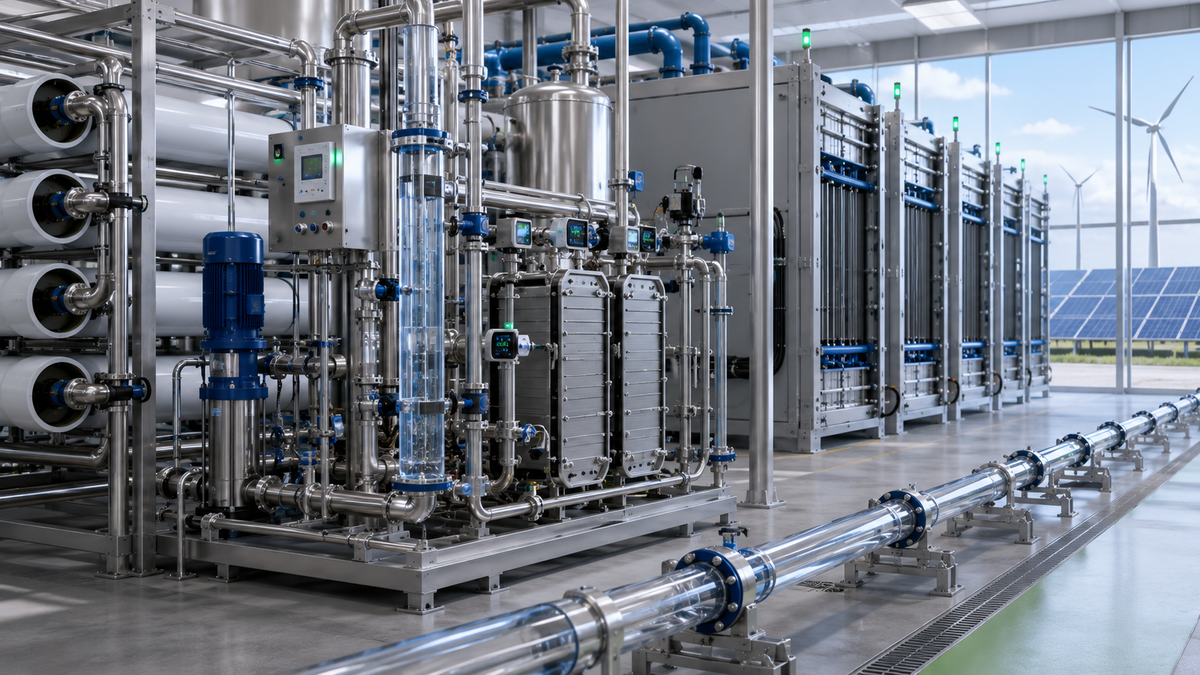
Recent geopolitical disruptions have once again reminded us how vulnerable energy-importing economies can be. For India, this is more than a policy discussion — it is a strategic imperative. With abundant solar and wind potential and strong momentum under the National Green Hydrogen Mission, India has a real opportunity to reduce fossil-fuel dependence, strengthen energy security, and position itself as a global producer of green hydrogen.
But there is a critical detail that still does not get the attention it deserves: water. In green hydrogen production, water is not a routine utility — it is a core feedstock fed directly into the electrolyser, and it is also needed to cool the stack. The projects that win will be the ones that respect both the big strategic vision and the small technical details. In green hydrogen, success will be decided at the microscopic level.
Water is a feedstock, not a balance-of-plant afterthought
It is easy to file water treatment under 'balance of plant' — a commodity line item to be value-engineered down to the lowest price. In green hydrogen, that instinct is dangerous. The water that enters an electrolyser becomes part of the electrochemical reaction itself. Its quality directly governs stack performance, efficiency, and life.
Electrolysers are not forgiving. Trace ionic contamination, dissolved metals, chlorides, and organics can foul membranes, poison catalysts, and accelerate degradation of the most expensive components in the entire plant. Poor water quality does not announce itself on day one — it shows up months later as creeping efficiency loss, rising energy consumption per kilogram of hydrogen, and shortened stack life.
Why the stakes are so high
With the cost of electrolysers forming roughly 30–50% of total project cost, the economics leave no room for casual water treatment choices. Reliability, efficiency, and stack life are too important to leave to generic, off-the-shelf assemblies. A water treatment shortcut that saves a fraction of the capital budget can quietly destroy the asset it was meant to support.
The arithmetic is brutal: the developer who understands this will be successful, and the one who doesn't will be staring at a dead stack and a red balance sheet.
This is specialised water, not ordinary process water
Producing and sustaining electrolyser-grade water is a discipline in its own right — closer to the rigour of boiler-water chemistry or semiconductor-grade ultrapure water than to conventional process-water treatment. It demands tight control of conductivity, continuous online monitoring, the right sequence of pre-treatment and polishing steps, and a design that holds water quality stable across real-world feed-water variability.
Successful projects will be built on a Quality by Design mindset — water quality engineered in from the start, not corrected after commissioning. That requires thoughtful engineering, genuine design thinking, and a clear view of total cost of ownership rather than lowest first cost.
- Treat ultrapure water specification as a process requirement, not a procurement afterthought
- Design pre-treatment for the worst-case feed water, not the brochure-case
- Build in continuous monitoring so quality drift is caught early, not after stack damage
- Evaluate every choice on lifecycle cost — energy, recovery, consumables, and stack longevity
Bring water expertise in on day one
If internal capability is limited, the single most valuable decision a developer can make is to bring qualified water treatment professionals into the room early — at the design and technology-selection stage, not after the electrolyser has been ordered. The cost of involving the right expertise up front is trivial against the cost of a degraded stack.
For the underlying numbers — water consumption per kilogram of hydrogen, PEM versus alkaline technology, cooling demand, and India's water-stress context — see our detailed companion guide on green hydrogen water requirements.
The bottom line
If we want green hydrogen projects that are truly green, reliable, and commercially viable, we must give water the importance it deserves from day one. The strategic vision is necessary — but it will be the microscopic details, governed by disciplined water treatment, that separate the projects that thrive from the ones that fail.
Frequently asked questions
Why does water quality matter so much in green hydrogen production?
Because the water fed to an electrolyser is part of the electrochemical reaction, not just a utility. Ionic contamination, dissolved metals, chlorides, and organics can foul membranes and poison catalysts, degrading the stack — the most expensive component in the plant. Poor water quality shows up as falling efficiency, higher energy use per kilogram of hydrogen, and shortened stack life.
How pure does water need to be for an electrolyser?
Electrolysers require ultrapure water with very low conductivity and tightly controlled ionic, metallic, and organic content — a specification closer to semiconductor-grade or high-pressure boiler-water standards than to ordinary process water. The exact target depends on the technology (PEM versus alkaline) and the OEM's stack requirements, which is why water quality must be engineered to the specific project.
What share of green hydrogen project cost is the electrolyser?
Industry estimates commonly put the electrolyser and related stack components at roughly 30–50% of total project capital cost. Because that asset is so capital-intensive and so sensitive to water quality, treating water treatment as a low-cost commodity item puts the largest investment in the plant at risk.
What is a Quality by Design approach to green hydrogen water treatment?
Quality by Design means engineering the required water quality into the system from the outset — specifying ultrapure targets as a process requirement, designing pre-treatment for worst-case feed water, and building in continuous monitoring — rather than discovering and correcting problems after commissioning. It is the difference between a plant designed for reliability and one patched for survival.
When should water treatment specialists be involved in a hydrogen project?
As early as possible — at the design and technology-selection stage, before the electrolyser is procured. Bringing qualified water treatment professionals in early lets the water system be matched to the stack and the feed water from day one. The cost of that expertise is trivial compared to the cost of a degraded or failed stack.