Ionic builds membrane and non-membrane water and wastewater treatment systems used around the world to treat many different types of water across many different industries — aerospace, cosmetics, pharmaceuticals, chemicals, personal care, home care, automotive, fish processing, mining, petroleum processing, municipal supplies, and resort water supplies, to name a few.
These industries typically have very specific requirements for scope and design — sometimes down to the font on a wire label, a preferred vendor, alloy, or arrangement. But once the project is complete, the spare parts question arises, and the response is often: "What do you recommend?" Or if specifications mention it, you might see something like "one year spare parts to be included." What is the appropriate response — and what does that even mean?
Why the spare parts conversation is so difficult
Over the years we've tried several approaches. One was to provide a fully priced spare parts list and let the client choose what they wanted. It didn't work well, for two reasons. First, the client rarely has the operational experience to make those choices. Second, putting the onus on the client creates action paralysis — they'd rather we make the recommendation.
But how do we make a recommendation when we typically have no information on the client's operations budget or how they actually intend to operate the system? When we propose what we consider a reasonable list, the response is often "we cannot afford that." The gap between what we'd like to see on the shelf and what the client wants to purchase is hard to close. We need a method that lets the client determine criticality — because that's what we're really being asked to do when handed a spare parts brief. The unspoken liability is that if a part fails and it's not on the list, we have failed the client.
Before getting to the framework we've landed on, here are some uncomfortable truths we've learned about spare parts.
Some hard truths about spare parts
Operational spares get squeezed out of the capital budget
Spares are often not part of the CAPEX. That's why, near project completion, we're frequently asked to re-order components that would have been more efficient to supply as part of the original scope. This is nearly universal across industries.
Willingness to spend depends on the budget source
Clients are usually happy to select the best alloys or most efficient plant design, knowing it costs more. But spare parts? Different story. Operations budgets are traditionally bare-bones. Very costly plants with significant capital expenditure are often staffed with as few personnel as possible and at relatively low training levels. Spares fall into the same line of thinking.
Warranty is not the same as availability
There's often confusion about warranty and spare parts. We hear "we don't need spares because we have a warranty." The confusion is between compensation for a failed component and the availability of one. Even a warrantied part has to be purchased, shipped, and installed. That can take many weeks — and the plant may be offline that entire time depending on the replacement period.
Stockroom RIP — Rust In Place
Spare parts, when they are supplied, are often abused and neglected. We've seen many cases of customer management who correctly and proactively purchased shelf spares and set up an inventory — only to find the parts unusable when needed. We call this a Stockroom RIP, or Rust-In-Place event. Spare parts inventories are often found waterlogged, rusted, stripped of sub-parts, lost, stolen, or otherwise neglected.
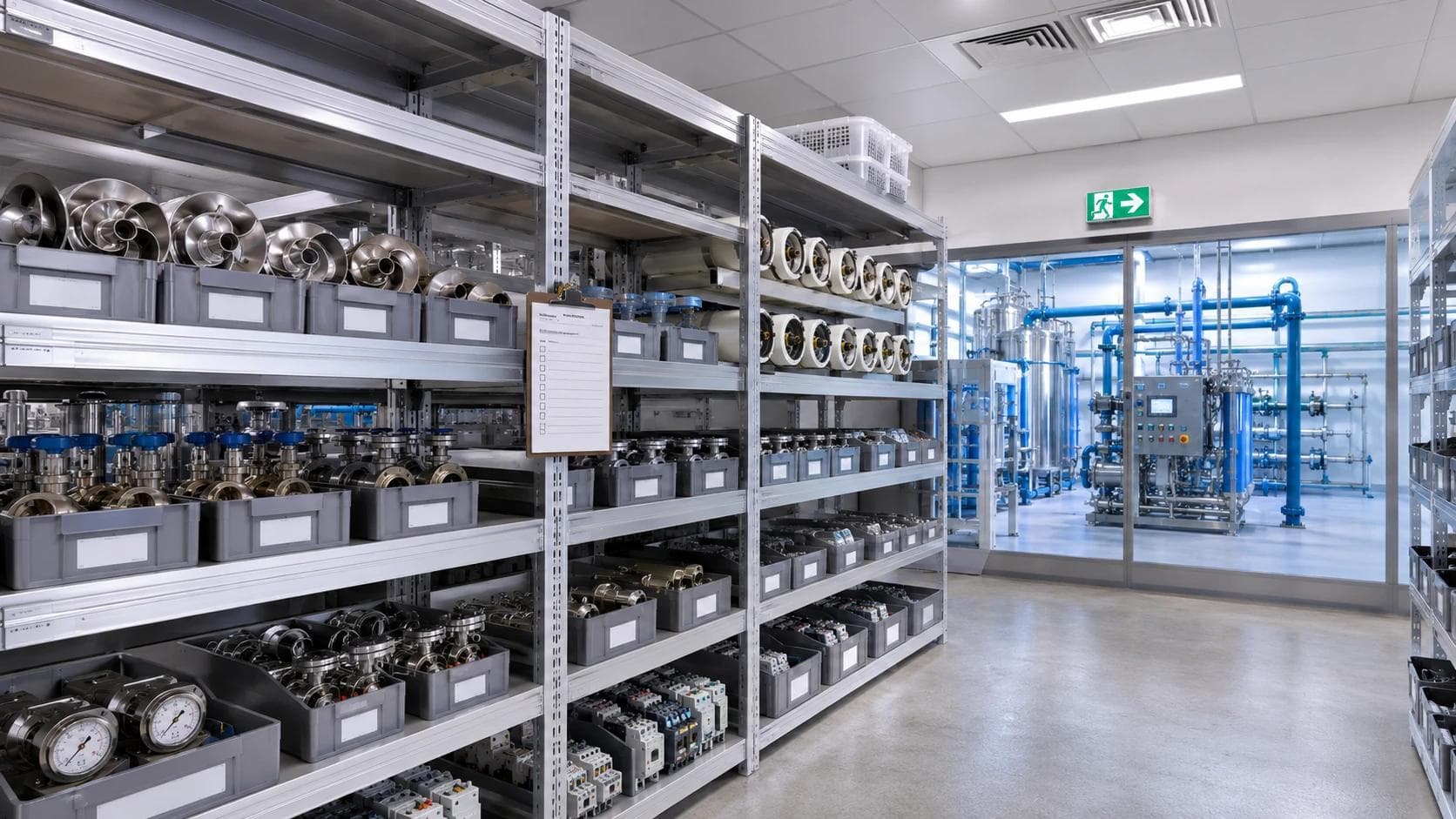
We now try to head this off early by recommending that storage areas isolated from the process areas be included in the overall plant layout. These areas should have proper shelving and climate control. For larger plants, we recommend a high-value spares area segregated from the rest of the equipment.
Field observation: The good news is the equipment was separated from the process area. The bad news is that nearly everything was corroded or obsolete, including many broken parts that had been retained after failure and returned to the shelf — a stockroom turned into an equipment dump where you can't tell what's new from old, or what works from what doesn't.
A five-question decision tree for spare parts stocking
To make the conversation actionable, we use a simplified scoring exercise to determine the right stocking level for a given plant. A 1-to-10 scale is used to produce a spares score. We've interspersed a worked example below in italics.
1. Are technically capable people available to service the equipment?
- 0 — We do all our own repairs
- 5 — We can do most repairs but need assistance on some items
- 7 — We have trouble retaining skilled employees for repair work, and subcontracted workmanship is often poor
- 10 — We cannot do any repairs and need outside assistance
Example answer: 7
2. How quickly can replacement goods be delivered to site from the manufacturer?
- 0 — Very quickly
- 5 — Several days
- 7 — Several days is typical, but we see delays due to customs or long holidays
- 10 — Weeks
Example answer: 7
3. What is the impact if the plant is offline? Are there alternate water sources?
- 1 — We can meet our water requirement with the plant offline
- 2 — We can meet our water requirements with an alternate source, although quality is much reduced
- 5 — We can meet some of our water requirement
- 10 — We cannot meet any of our water requirement
Example answer: 1
4. What is the cost if the water supply is interrupted?
- 0 — Very little cost; we can wait it out
- 5 — Moderate cost (e.g., we pay more for local water deliveries, but the option is available)
- 10 — High cost
Example answer: 5
5. Is there a spare parts management system?
Defined here as a system where new parts get ordered when consumed and where parts are stored properly and in climate control.
- 0 — There is a good spare parts management system
- 5 — There is no formal system but we can keep track
- 8 — We don't have a good management system; we sometimes can't find spares or forget that we've used them up
- 10 — There is no system
Example answer: 8
Scoring and budget
Sum the five answers and multiply by 2. In our worked example: 7 + 7 + 1 + 5 + 8 = 28, and 28 × 2 = 56. That is the percent of the total spare parts inventory budget the owner should have on site.
In other words, if the full recommended spare parts list would cost ₹X, the operations manager should budget 56% of X. That budget then guides purchase of the most likely maintenance items — generally electrical equipment (because of poor power quality) and controls equipment.
Why this framework works (and where it falls short)
This system is non-scientific, somewhat crude, and includes flaws — and it can almost certainly be improved. It is barely scientific compared to a mean-time-between-failure (MTBF) analysis, but in practice MTBF is impractical for most small-equipment customers.
An obvious shortcoming: for some customers, downtime is so costly that they need full spares inventory at all times regardless of any score. That may be true, but such a client is also a strong candidate for redundancy — and redundancy itself reduces spare parts requirements by buying time to purchase, ship, and install a replacement.
Location also matters. Some sites have notoriously poor power supply conditions where electrical equipment fails frequently even with filtering and surge suppression. In those locations, motors, computers, VFDs, and similar items have high failure rates and need higher stocking, regardless of the score. Selection in such cases relies on as much art and experience as it does on any kind of analysis.
That said, the exercise of generating a score tends to make the stocking issues explicit — and it shifts the decision-making from supplier to customer. It surfaces considerations that might otherwise be overlooked. It reduces the difficult task of trying to predict the failure rate of a plant somebody else is operating, and it reduces our liability of having to propose a budget for vendor parts that will fail at some point in the future. Because it's rare for the entire spare parts list to be purchased, the discussion can stay focused on value and priority. If the owner elects to trim the recommended spares budget, this method gives them a defensible way to do so.
The questionnaire can certainly be expanded — additional questions could help pin down stocking and budgets more tightly. For example: "are you feeling lucky?" We have plants in very remote areas where management decided on zero spare parts inventory, and they were lucky — until one day they weren't.
Frequently asked questions
How many spare parts should I stock for a water treatment plant?
There is no single right answer because it depends on plant criticality, repair-skill availability, lead times, and local power quality. The five-question decision tree above produces a defensible percentage of the full spares list to keep on site — most owners land somewhere between 30% and 70% of the supplier's recommended inventory.
Is a warranty a substitute for spare parts?
No. A warranty compensates you for a failed component but does not make a replacement instantly available. Even a warrantied part must be diagnosed, requisitioned, manufactured (if not in stock), shipped, cleared through customs, and installed — which can take weeks. If the plant cannot tolerate that downtime, on-site spares are the only realistic mitigation.
Why are spare parts often missing from the capital budget?
Spares are perceived as an operational expense, not a capital one. Capital approvals focus on the plant itself; operations budgets are funded separately and are typically much tighter. The result is that critical spares often get deferred — and procured reactively after the project is closed out, at higher cost and with longer lead times.
What is a Stockroom RIP?
Stockroom Rest-In-Place — when correctly purchased spares are stored badly (waterlogged, exposed, mixed with broken parts) and are unusable when finally needed. Avoid it by isolating the spare parts store from the process area, providing proper shelving and climate control, and segregating high-value spares.
When does redundancy reduce the need for spare parts inventory?
When redundancy gives operations enough buffer time to purchase, ship, and install a replacement without losing service, the urgency of holding the part on the shelf drops. Redundancy doesn't eliminate spares — it changes the criticality scoring. A plant with full redundancy can usually tolerate a lower stocking percentage than one without.